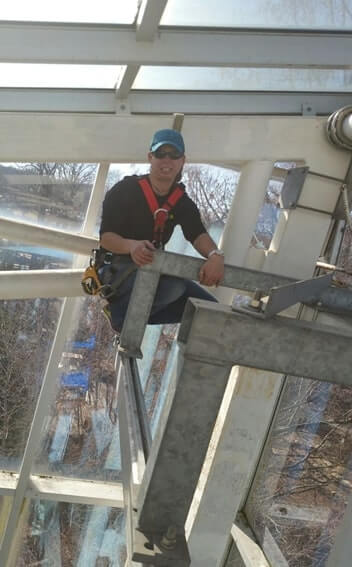

Everyone is responsible for preventing falls when working at heights. The building owner/property manager/owner’s representative, the self-employed contractor, any subcontractor and the worker are all responsible for safety considerations when on a roof.
The concern for health and safety on a roof becomes critical as soon as someone steps onto it (and not just when they “get close” to the edge). All aspects of working safely at heights should be considered. The general rule is that fall protection is required:
- In Canada, where any section of the parapet wall is less than 36 inches (and someone is subject to a 10-foot fall)
- In the USA, where any section of the parapet wall is less than 42 inches (and someone is subject to a 4-foot fall)
Preventing falls from heights is a priority for the Department of Labour (DOL) and the Ministry of Labour (MOL). Each expects contractors and employers with staff working at heights to actively manage any significant hazard.
Controlling the Hazard
To stay safe when working at heights, you must ensure effective controls are in place to prevent harm to people.
To select the most effective controls, you must consider the following steps:
- Eliminate the chances of a fall by doing as much of the preparation work as possible before work begins. Normally, this is done by doing a fall hazard roof assessment. The assessment report will review all aspects of safe access and egress for all work activities that may take place on the roof. The intent is to isolate the worker from the risk of a fall by using guard rails, scaffolds and roof edge protection as means of prevention. In some situations, a combination of controls will be required to ensure safe work.
- Edge protection is imperative. Edge protection should be used to isolate workers from falls. This includes guardrails, horizontal lifelines, localized tieback and lifeline anchors, access ladders, and catwalks. Edge protection should be provided on all exposed edges of a roof, including the perimeter of buildings, skylights, and other fragile roof materials, and for any openings in the roof. This also applies to openings and edges of floor areas.
- Where there is a risk of workers falling through roof openings, the openings should be identified and guarded.
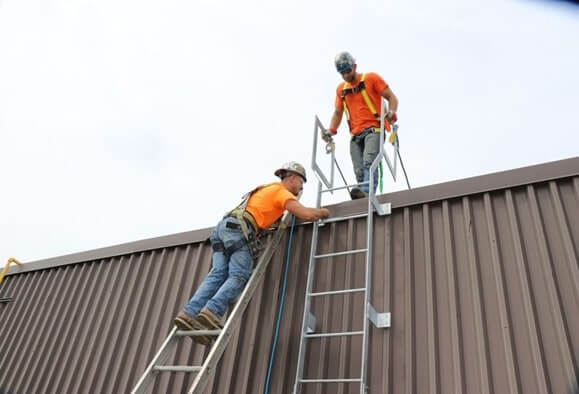
Check List for Working Safely on a Roof
- Are workers trained or supervised to work on a roof, near the roof edge or over the edge using suspended equipment safely?
- Has a full hazard assessment been completed before work starts?
- Is there safe access to all roof areas?
- Has the contractor provided a work plan to safely access the building edge or facade?
- Have the roof and fall arrest system been inspected, reviewed and tested if needed?
- Have all the access restrictions been identified and understood by the contractors?
- Are workers protected from falling off roof edges, and do they have a rescue plan?
- Are workers protected from falling from incomplete roofs?
- Are workers protected from falling through skylights, penetrations, or other brittle roofing?
- Are people below the work protected from the dangers of falling materials?
- Do roof workers have appropriate footwear to prevent slips?
- Are the weather conditions suitable for working on a roof?
- Have lower electrical hazards and vehicle traffic hazards been identified?
Other Possible Considerations
- Eliminate the hazard of a fall from a roof.
- Work from the ground.
- Work from inside where there is no possibility of a fall.
- Prefabricate components at ground level or prior to installation.
- Remove complete fixtures to ground level or to the shop for maintenance (e.g., air conditioning units).
- Pre-paint fixtures/roof prior to installation.
- When isolating the hazard of a fall from a roof, consider additional temporary protections.
- Scaffolding and mobile scaffolds/step platforms/working in an elevating work platform.
It is the law, so doing nothing to address safety when working at heights is not an option!